
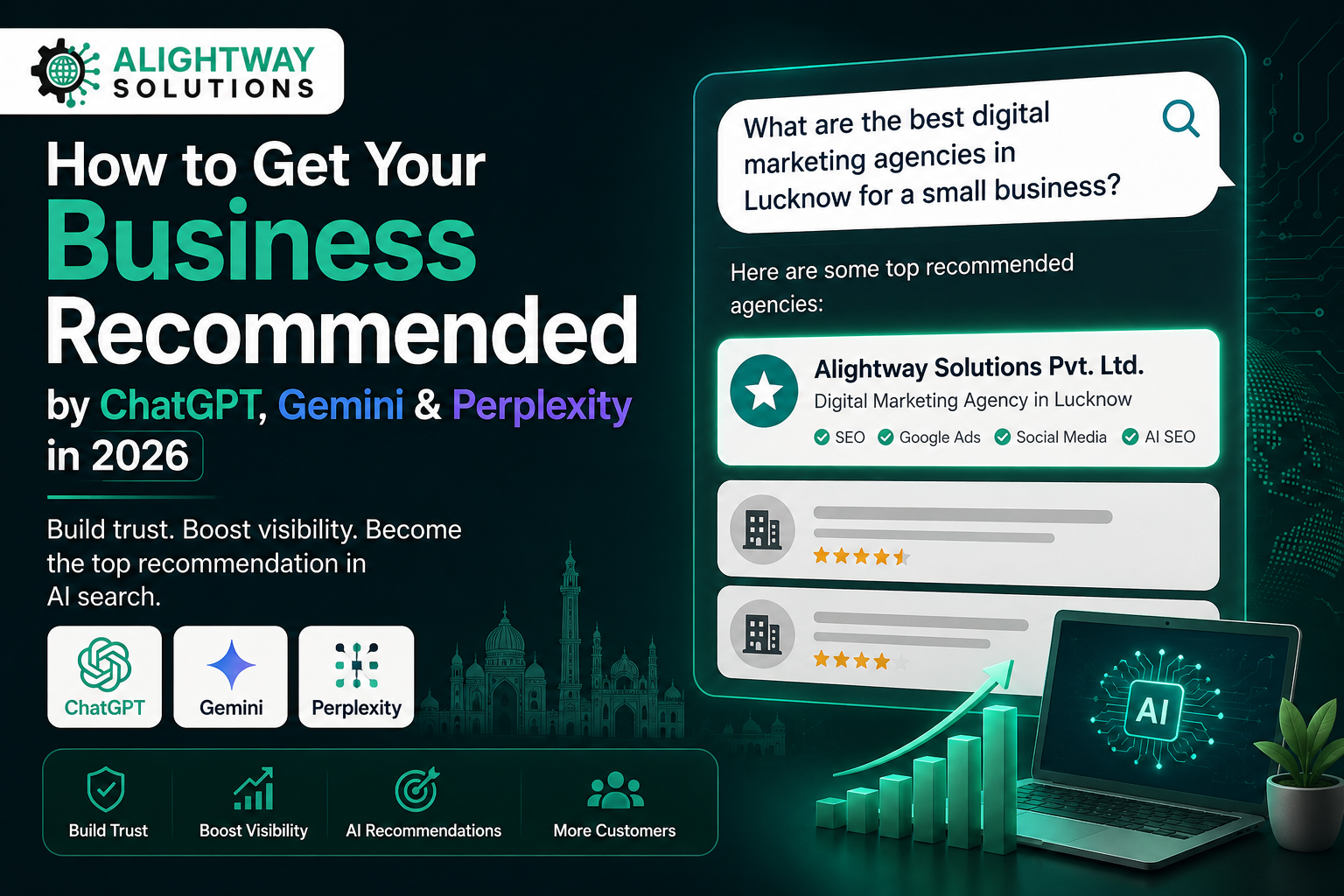
Imagine a potential customer asks:
"What are the best digital marketing agencies in Lucknow for a small business?"
Instead of opening Google and scrolling through ten blue links, they ask ChatGPT, Gemini, or Perplexity and receive a shortlist of businesses.
If your company isn't mentioned, you may lose the customer before they ever visit Google or your website.
This is the new frontier of Generative Engine Optimization (GEO).
The good news? You cannot directly submit your business to ChatGPT, Gemini, or Perplexity and demand a recommendation. There is no legitimate "AI ranking button." Instead, you need to build a strong digital footprint that gives AI-powered search systems enough relevant, consistent, credible, and verifiable information to understand your business.
OpenAI states that ChatGPT Search ranks results using multiple factors intended to identify relevant and reliable information, while also noting that top placement cannot be guaranteed. Websites must also allow OpenAI's OAI-Searchbot to crawl them if they want to be eligible for ChatGPT Search.
What Is AI Business Recommendation?
AI business recommendation is when an AI-powered search or conversational system identifies your company as a relevant option for a user's specific need, location, budget, industry, or preference.
For example:
User: "Recommend affordable wedding photographers in Lucknow."
An AI system may evaluate businesses based on factors such as:
Relevance to the query
Location
Services offered
Website information
Reviews and reputation
Third-party mentions
Business listings
Freshness of information
Authority and credibility
Available supporting evidence
The exact systems and ranking mechanisms differ between platforms, so there is no universal formula.
That is why the objective should not be "hack ChatGPT."
The objective should be:
Become the most credible and easily understood entity for your category.
1. Build a Strong Business Entity
The first step in GEO is entity clarity.
AI systems need to understand exactly what your business is, what it does, where it operates, and who it serves.
Your website should clearly communicate:
Business Name → Category → Services → Location → Audience → Expertise → Proof
For example:
"ABC Digital is a digital marketing agency in Lucknow specializing in SEO, Google Ads, social media marketing and AI search optimization for local businesses."
This is much more useful than vague branding language such as:
"We transform brands through innovative digital experiences."
Creative copy has its place, but AI systems and users also need specific facts.
Keep your business name, address, phone number, service descriptions, locations and other important details consistent across your digital ecosystem.
2. Make Your Website the Primary Source of Truth
Your website should be the central knowledge hub for your business.
Create dedicated pages for important services instead of putting everything on one generic "Services" page.
For example:
SEO Services
AI SEO Services
AEO Services
GEO Services
Google Ads
Social Media Marketing
Local SEO
Industry-specific solutions
Location-specific services
Case studies
About the company
Contact information
Every important service should explain:
What you do + who you help + where you operate + how you work + why you're different + evidence of results.
This gives search systems significantly more context from which to understand your entity.
3. Create Content That Answers Recommendation Queries
Traditional keyword research often focuses on phrases such as:
"SEO agency Lucknow"
GEO requires thinking beyond the keyword.
Consider the questions customers might ask AI:
What is the best SEO agency in Lucknow?
Which digital marketing company is good for startups?
Who provides affordable SEO services?
What are the best agencies for local SEO?
Which company specializes in real estate marketing?
Which agency has experience with small businesses?
Create content around these decision-making questions.
A strong article might be:
"Best Digital Marketing Strategies for Real Estate Businesses in Lucknow"
Another could be:
"How to Choose an SEO Agency for a Small Business"
These pages demonstrate topical expertise while addressing the information customers need before making a decision.
4. Develop Topical Authority
One article rarely establishes authority.
Build a topic cluster around your primary business category.
For an SEO agency, the cluster could include:
SEO → Local SEO → Technical SEO → AI SEO → AEO → GEO → Google AI Overviews → Content Marketing → Google Business Profile → SEO Analytics
Then connect related articles with contextual internal links.
This helps establish relationships between your company and the topics you claim expertise in.
The objective is to make your website more than a brochure.
Make it a knowledge source.
5. Earn Third-Party Mentions
This is one of the most important GEO concepts.
Your business should not exist only on its own website.
Build legitimate mentions through:
Industry publications
Local news websites
Business directories
Professional associations
Relevant interviews
Podcasts
Expert contributions
Local business websites
Case-study publications
Reputable review platforms
Think of this as digital corroboration.
If your website says:
"ABC is a leading SEO company."
That is a self-claim.
If multiple credible external sources independently discuss ABC's SEO expertise, services, achievements, or industry specialization, the broader web provides additional context.
Do not manufacture fake mentions or spam directories. Quality and relevance matter more than volume.
6. Build Review and Reputation Signals
Reviews are particularly important for local businesses.
Maintain accurate profiles and actively encourage genuine customers to leave honest feedback.
More importantly, reviews should naturally describe the actual services customers received.
For example:
"They helped us improve local SEO and generate more enquiries."
This provides considerably more contextual information than a generic:
"Excellent company!"
Never buy or fabricate reviews.
The objective is to create a trustworthy reputation footprint, not artificially manipulate AI systems.
7. Optimize for Local AI Recommendations
If your business serves a specific city, location signals become extremely important.
Clearly communicate:
City
Areas served
Physical location, when applicable
Service areas
Local projects
Local customers
Local case studies
Business hours
Contact details
Maintain accurate information on your Google Business Profile and other relevant business platforms.
For example, don't simply write:
"Best salon."
Build a stronger entity:
"ABC Salon is a women's salon in Gomti Nagar, Lucknow, specializing in bridal makeup, party makeup, hair styling and skincare services."
Specificity makes your business easier to understand.
8. Make Your Content Easy for AI to Understand
GEO does not mean writing robotic content.
Quite the opposite.
Write naturally, but structure information clearly.
Use:
Descriptive headings
Short paragraphs
Direct answers
Lists
Tables
FAQs
Definitions
Examples
Statistics
Expert commentary
Original research
Case studies
For example:
What services does ABC Digital provide?
ABC Digital provides SEO, Google Ads, social media marketing, local SEO, AEO and GEO services for businesses in Lucknow and across India.
Then provide the detailed explanation.
This answer-first structure works well for human readers and answer-oriented search experiences.
9. Make Your Website Crawlable
Outstanding content is useless if important pages cannot be discovered.
Check:
Robots.txt
XML sitemap
Indexability
Canonical tags
Internal links
Page rendering
Mobile usability
HTTP status codes
JavaScript accessibility
Structured data
For ChatGPT Search specifically, OpenAI says websites should allow OAI-Searchbot to crawl the site and should ensure their hosting or CDN permits traffic from OpenAI's published searchbot IP addresses.
This is a technical requirement worth checking before investing heavily in GEO content.
10. Use Structured Data Correctly
Schema markup can help search engines understand entities and relationships, but it is not a magic GEO ranking switch.
Use appropriate structured data where relevant, such as:
Organization
LocalBusiness
Person
Article
Product
Service
Breadcrumb
FAQ, where eligible and appropriate
The critical rule is simple:
Structured data should accurately represent information visible on the page.
Don't add irrelevant schema simply because an SEO tool recommends it.
Google's current guidance emphasizes that AI search optimization builds on normal SEO fundamentals rather than requiring a secret AI-specific ranking trick. Its 2026 documentation also emphasizes unique, non-commodity content and useful text, local, shopping, image and video information.
11. Publish Original Information
This may become one of the strongest competitive advantages in AI search.
AI can summarize information that already exists.
Your opportunity is to create information that doesn't already exist everywhere.
Publish:
Original research
Customer surveys
Case studies
Before-and-after results
Expert interviews
Industry benchmarks
Proprietary statistics
Local market insights
Original photographs
Practical experiments
For example:
Instead of:
"10 SEO Tips for Real Estate Companies"
publish:
"Our 6-Month SEO Experiment for a Lucknow Real Estate Business: Traffic, Leads and Conversion Data."
The second provides unique evidence.
12. Optimize for All Three: SEO + AEO + GEO
The smartest strategy is not to choose between traditional SEO and AI search optimization.
Use a combined framework:
SEO
Get discovered.
AEO
Get understood as an answer.
GEO
Become visible within generative recommendations and AI responses.
Google's own 2026 guidance similarly positions optimization for generative AI features as an extension of strong SEO practices rather than a completely separate search system.
Can You Guarantee That ChatGPT Will Recommend Your Business?
No.
Anyone promising guaranteed ChatGPT, Gemini or Perplexity recommendations should be treated cautiously.
AI systems can change their retrieval methods, ranking signals, sources and responses. Even when your business appears today, there is no guarantee it will appear for every user or query tomorrow.
OpenAI explicitly states that ChatGPT Search placement cannot be guaranteed.
The realistic goal is to increase the probability of being considered and cited when your business genuinely matches the user's requirements.
How to Measure GEO Success
Traditional SEO metrics are still important, but add AI visibility metrics.
Track:
AI mentions
AI citations
Brand visibility
Recommendation frequency
Share of AI responses
Referral traffic
Branded searches
Organic traffic
Leads
Conversions
Review growth
Third-party mentions
Create a testing system around real customer prompts.
For example, test:
"Best SEO agencies in Lucknow"
"Affordable SEO companies in Lucknow"
"Best AI SEO agency for small businesses"
"Who provides local SEO in Lucknow?"
Run these tests periodically across relevant AI platforms and record which businesses appear, which sources are cited and how your brand is described.
This gives you a practical AI visibility benchmark rather than relying on assumptions.
Frequently Asked Questions
1. How do I get my business recommended by ChatGPT?
Build a strong, crawlable website with accurate business information, authoritative content, genuine reviews and credible third-party mentions. For ChatGPT Search, also ensure OAI-Searchbot can access your site. There is no guaranteed submission or ranking method.
2. Can I pay ChatGPT to recommend my business?
You should not assume that paying for advertising or SEO guarantees organic AI recommendations. AI-generated recommendations and advertising are separate concepts, and organic placement cannot simply be purchased.
3. How do I get my business mentioned by Gemini?
Focus on building a recognizable and trustworthy web presence: accurate business information, strong content, authoritative references, reviews and consistent entity signals. There is no legitimate shortcut that guarantees a Gemini recommendation.
4. How do I get recommended by Perplexity?
Create authoritative, crawlable content that directly answers relevant customer questions and earn credible external references. Perplexity-style search experiences can cite web sources, so being a useful and trustworthy source is more valuable than keyword stuffing.
5. What is GEO in digital marketing?
GEO, or Generative Engine Optimization, is the practice of improving a brand's visibility and representation across generative AI search and answer experiences.
6. Is GEO replacing SEO?
No. GEO is not a replacement for SEO. Technical SEO, content quality, crawlability, authority and relevance remain fundamental to AI-powered search visibility.
7. Do backlinks help with GEO?
Relevant, credible references can contribute to the broader authority and discoverability of a business. However, GEO should not be reduced to simply acquiring more backlinks. Context, relevance, quality and entity consistency matter.
8. How long does it take to get recommended by AI?
There is no fixed timeframe. It depends on the strength of your existing digital presence, content authority, reputation, crawlability, competition and the queries being tested.
Conclusion:
Getting recommended by ChatGPT, Gemini and Perplexity in 2026 is not about finding a secret AI ranking trick.
It is about building a business that is easy to discover, easy to understand, easy to verify and difficult to ignore.
Your winning GEO framework is:
Clear Entity + Technical SEO + Original Content + Topical Authority + Genuine Reviews + Credible Mentions + Consistent Business Data + Answer-First Content + Continuous AI Visibility Testing
The future of search isn't simply:
"Where does my website rank?"
The better question is:
"When my ideal customer asks an AI who they should choose, does my business have enough credible evidence to become part of the answer?"
That is the real objective of GEO in 2026.